
Tucumã butter Astrocaryum vulgare
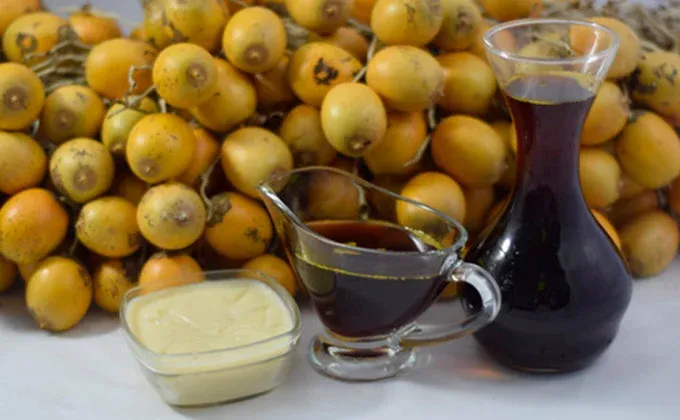
Tucuma butter is very similar to palm kernel butter in appearance, consistency and property but with higher and favorable melting point. It is known that butter with lauric acid has a key role in immune system function and prevention of various diseases. Due to its grease composition and unsaponifiable matter Tucuma butter forms a protective film on the skin and hair without causing damage to the lipid exchange.
Technical data
| INCI | Awaiting data sheet |
|---|---|
| CAS | 98143-57-8 |
| Origin | Awaiting data sheet |
| Plant part | Awaiting data sheet |
| Extraction method | Awaiting data sheet |
| Composition | Awaiting data sheet |
| Applications | Awaiting data sheet |
| Packaging | Awaiting data sheet |
| Minimum order | Awaiting data sheet |
| Lead time | Awaiting data sheet |
| Certifications | Awaiting data sheet |

Synonym: awara
HARVESTING SEASON
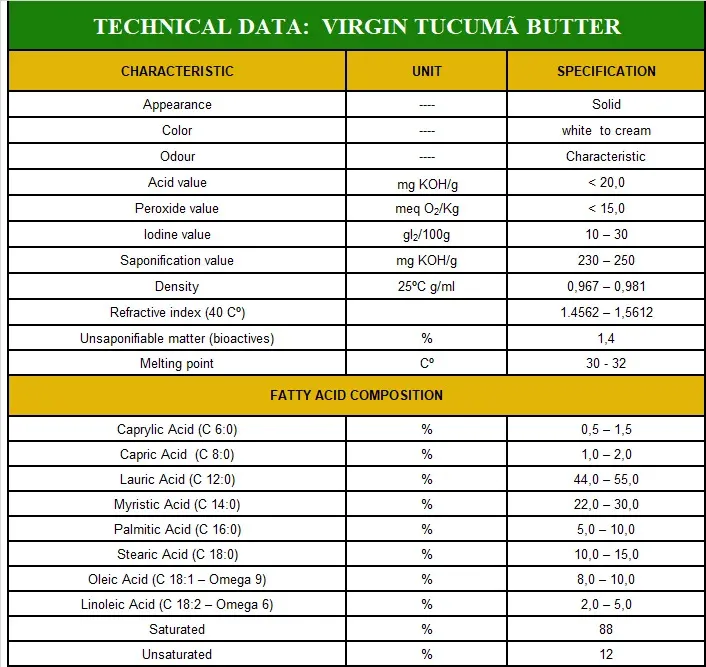
FATTY ACID COMPOSITION AND PHYSICAL-CHEMICAL DATA
Forms a transparent protective film on the skin, similar silicone without clogging the pores. The lipid exchange of the skin is not damaged and works well on dry skin and even on oily ones.
Tucuma butter are excellent for formulations for dry hair with split ends. Penetrates the cuticle of the hair to replace the loss of structural lipids and replenish moisture, giving back the natural elasticity, leaving them soft, strong and silky. Highly recommended for formation of curled hair and regeneration of ethnic hair.
POPULAR USAGE
The fiber has many uses; the leaves provide a very resistant fiber, ideal for basketry, the seeds are used in handicrafts, and the fruits are consumed raw or in the form of a juice called “wine of Tucuma,” which is mixed with water or made into ice cream. In addition, the pulp is very nutritious, containing one of the highest concentrations of provitamin A “beta-carotene” (52 milligrams per 100 g pulp), equaling the value found in the pulp of buriti. In comparison, the concentration of beta carotene in carrots is 6.6 milligrams/100 g pulp. Its oil is used in cooking and in massages.
ECOLOGY
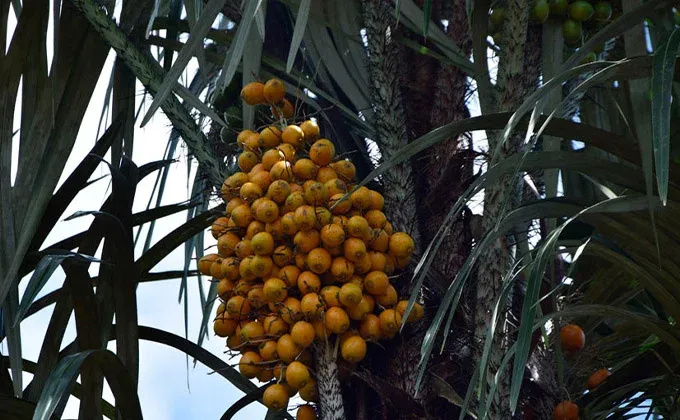
This species is native to the Amazonian region, possibly to the state of Pará, where it has its distribution center, and reaches French Guiana and Suriname. It is a characteristic palm of terra firme, low vegetation cover, or even open fields. There are two species of Tucuma in the Amazon, Tucuma-do-para (Astocaryum vulgare) and the Tucuma-do-amazonas (Astrocaryum tucuma). The tree of Tucuma-do-para is 10 to 15 m in height and regenerates quickly by growing multiple stems, while the Tucuma-do-amazonas can reach 25 m in height and forms a solitary trunk. Its fruits are also larger, and its pulp is fleshier, less fibrous, and less sweet than the pulp of Tucuma-do-para.
The Tucuma palm is considered a pioneer plant of aggressive growth, can grow new shoots after a fire, and mainly inhabits secondary forests and pastures. Seeds take up to 2 years to germinate. The plants grow slowly in cultivation and produce fruits after eight years. Some isolated oil palm (Elaeis guineensis) growers are beginning to replace the oil palm with Tucuma even without receiving support from research institutions to improve this species genetically. Its resistance to diseases and high productivity make this species an alternative for biodiesel production since the operating costs of an orderly plantation are much less than that of the oil palm.
The seed of Tucuma-do-para is covered externally with oily orange pulp. On average, the fruit weighs 30 g; 34% corresponds to the external pulp, with 14% to 16% of the oil when raw. A mature tree can produce up to 50 kg of fruits annually (25 kg per tree on average), corresponding to 2.5 kg of pulp and 1.5 kg of seed oil. Four hundred palm clusters can be planted in one hectare, each with three trunks. In total, this equals 1200 palm trunks and will result in 4.8 tons of fatty material per hectare, more than the oil palm, Elaeis guineensis, which produces only 4 tons of oil on average per hectare per year (assuming a harvest of 20 tons of fruits and an extraction of 22% oil). The advantage of Tucuma-do-para is that it forms clusters that do not need to be replanted, which is not the case for Elaeis guineensis.
REFERENCES
ALMEIDA, A. G. et. al: Beta caroteno na prática clínica, Instituto de Metabolismo e Nutrição, http://www.nutricaoclinica.com.br/beta-caroteno-na-pratica-clinica.html (acessado 17/11/2009)
BORA, P. S. et. al.: Characterization of the oil and protein fractions of tucuma (Astrocaryum vulgare Mart) fruit. 2001, Ciencia y Technologia Alimentaria, Ourense, Espanha, v. 3, n. 2, p. 111-116.
CALVACANTE, P. B.: Frutas Comestíveis da Amazônia, 1996, 6a Ed , Edições Cejup – Museu Paraense Emílio Goeldi, Belém.
MORAIS, L. : Banco de Dados Sobre Espécies Oleaginosas da Amazônia, não-publicado.
Quote or sample
Tell us the quantity and the factory will come back to you with a quote.